It is often said that Madan Mohan received more recognition and acknowledgement of his contribution after his demise. Indeed, his colleagues, the media, his fans, were lavish in praise for the late composer in all the tributes they paid him when he died and continue to give him respect even more than 30 years later. Respect for Madan Mohan has only escalated over the years as more and more people discover his music and the impact it had on the listeners.
Jatin Pandit Well-known composer of the Jatin-Lalit duo
Since my childhood, I have been hearing praises showered on Madanji. My father, being a classical singer, always appreciated Madanji's music. As I grew up and started understanding music. I realized that Madanji's songs were the outcome of deep reflection and meditation. What strikes me most about his music is the constant urge to experiment and do things differently, be it singing or with the instrumental accompaniment. He has, in fact, very smartly used Raag Nand (Anandee) that was almost neglected in film music. The song Tu Jahan Jahan Chalegaa(Mera Saaya 1966) in this raag, came as a pleasant surprise to everybody. If you listen to his songs carefully, be it a mujra, a qawwali or a ghazal you will realize that he was simply out of the world.
A tune, set by a music director, should instantly strike the chord with the audience. Only such scores become eternal melodies. This, of course, was Madanji's expertise. His compositions overwhelm you. No composition of any other music director has had such an effect on me. His Shaayaree (Poetry) was just too good for words. He has set melodies to films that dealt with non-musical topics. Yet, his melodious music has turned those films into classics. One example that comes to mind off hand is Haqeeqat (1964). It was essentially a war film. Nonetheless, it met with great success. Till date, several war films have been made, but no music director could reach the level of Madanji's tunes. This is a startling truth.
I had heard that Madanji was an extraordinary singer himself and I realized this only when I listened to the song Mai Rie Main Kaase Kahoon from the film Dastak (1970). I heard the song several times. It is the ultimate melody possible. It is also proof of what a music director, who is also a singer, can do to a song. Anybody can set a tune; but if a music director is also a good singer, he can craft the song well, design its finer points and embellish it with finesse. He can also beautify the song and effortlessly give it a logical finishing. Otherwise, when you set a tune you have to depend on the singer's capability to adorn it. Furthermore, if a music director is also a singer, he can communicate effectively with his signers, which in turn proves beneficial for both. Madanji's songs communicate effectively with his singers, which, in turn proves beneficial fo both. Madanji's songs certainly reflects his singing talent.
Madanji very cleverly chose his singers. We cannot imagine any singer in the place of the ones he selected.The other day, I was watching Kishoreda singing Zaroorat Hai Zaroorat Hai from the film Manmauji (1961) and I was very impressed. I played the VCD again and again and heard it 25 times. Madanji's composition not only did justice to Kishoreda's talent but also had explored it to the hilt.
About Lataji, what can I say? The work that Madanji and Lataji did together leaves us wonderstruck. What fantastic songs and what heavenly tunes! I feel that Lataji had the intuitive power to understand what Madanji expected from her. His conception was translated into reality by Lataji. Rafisaab was an equally talented alchemist.
I feel that a song is like a child who needs to be groomed. Some of the loose ends in a song need to be joined together. We give a lot of importance to the sign line. So the composition should be such that the stanza would aptly land on the sign line. Only then the tune is perfect. Many a time the stanzas do not easily lead to the sign line. Then the gap between the stanza and the sign line is bridged by a musical piece. This gives a patchy effect to the composition and there is no continuity. If you want to understand this phenomenon, listen to the song Ye Duniya Ye Mehfil. All the four stanzas of the song are set to different melodies and have different interludes, but all the stanzas link up easily with the sign line. There is absolutely no patchwork. This is the characterstic feature of a music composer par excellence. Everytime I listen to this song, I learn something new.
Though Madanji had a supurb track record, he was never on the forefront when he was alive. Today you may hunt high and low, but you will never find another Madan Mohan. He was one and the only one of his kind. Several music directors who were ready to compromise for the sake of commercial success went ahead in their career, but Madanji was not of this type. It is extremely difficult to find genuine people like him.
During Madanji's days, devotion, dedication and genuineness were given priority. Mediocrity was not accepted. It was a period when even actors on the silver screen were music aficionados. They understood the emotions of songs and emoted accordingly on the screen, thereby giving life and soul to film music. In contrast, today's music scene is very depressing. Our generation was inspired by music directors like Madanji. God alone knows what inspires the present generation!
(This article excerpted from the book "Madan Mohan - Ultimate Melodies" by Vishwas Nerurkar)







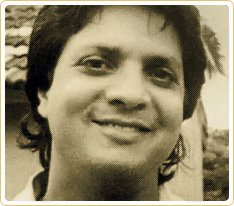 Since my childhood, I have been hearing praises showered on Madanji. My father, being a classical singer, always appreciated Madanji's music. As I grew up and started understanding music. I realized that Madanji's songs were the outcome of deep reflection and meditation. What strikes me most about his music is the constant urge to experiment and do things differently, be it singing or with the instrumental accompaniment. He has, in fact, very smartly used Raag Nand (Anandee) that was almost neglected in film music. The song Tu Jahan Jahan Chalegaa (Mera Saaya 1966) in this raag, came as a pleasant surprise to everybody. If you listen to his songs carefully, be it a mujra, a qawwali or a ghazal you will realize that he was simply out of the world.






